Ingredients for salmon (serves 4)
4 salmon filets (wild salmon or organic salmon)
40 g butter (at room temperature)
Lemon juice
Cayenne Pepper
1 tablespoon of grated horseradish
30 g smoked salmon
100 g fresh grated white bread without crust
Salt, pepper, olive oil
For the sauce
120 ml fish stock (or bouillon cube)
50 ml Chardonnay
20 ml Vermouth
150 ml thick cream
Salt, pepper, lemon juice
Preheat the oven to 200° C (top heat). Stir the butter with a mixer until its soft and creamy, then add all the other ingredients (except the salmon filets) and continue mixing.
Place the salmon filets on baking paper on a baking tray and cover each one of them with the farce of smoked salmon and horseradish and put them in the oven. The fish will be cooked in about 7 minutes only! The farce on top of the salmon should be slightly brow. If it’s not, put briefly under the grill.
Just before you place the fish in the oven, put the fish stock along with the white wine and the vermouth into a saucepan and boil down over high heat. Add the cream and let it boil again, until the sauce looks nice and creamy.
Serve the salmon and the sauce with briefly in butter sauteed spinach, basmati rice and a lively Champagne Extra Brut “blanc de blancs” (100% Chardonnay).
About the French understanding of the hierarchy in taste
To sense the way we are thinking and tend to build our wines you should take a close look at the understanding French of cuisine and food. They believe indeed in a sort of hierarchy of taste appealing to the intensity, finesse, complexity and originality of a dish. However, the rarity of the ingredients, as well as preparation and cooking also play a major role.
Truffe
TRUFFLES are a good example of this culinary world view “à la française”. Their dependence on soil, climate and vintage make it a rare product. After finding them by using the sensory apparatus of a dog, a pig or a fly and carefully digging them out, you should act quickly, because its limited shelf life (you also freeze them, but a thawed truffle loses the solidity of the tissue). You should also proceed with caution when cleaning the fungus with a little brush to remove even the last grain of sand from the rough surface to avoid damage to the firm, yet soft tissue. However, there obviously are only few people who are able to refine its taste by cooking as the flavours of the fungus seem to vanish by heat. Hence, simply slicing them over an omelette, buttered mashed potatoes or a pan-seared pheasant remains the best way to enjoy this wild “crop”. A genuine taste of nature!
Let’s stay with the mushrooms and have a look at MORELS. Although less rare than the enigmatic truffles, yet they offer amazingly complex and generous tastes and flavors. Just like truffles, their fruit has remained completely wild, cultivated only by nature. Consequently gourmets of this world have to reconvert into a primeval “hunter-gatherers” if ever they ever want to satisfy their zeal for its unique perfume. Delicate winged game combines well with their finesse and a simple and creamy risotto gives some body to the flavours of this precious mushroom.
A creature from the forests, stout and solid! BOLETUS appeals to the most powerful of tastes, the Japanese “UMAMI”, translated best by “TASTY” or “SPICY”. Freshly cut and fried it provides a complete meal. But once it has been dried, it develops its almost overwhelming aromas that confer impressive depth and length to all kinds of sauces and stews. A strong personality, proudly representing noble country kitchen on the finest tables in the world.
2 ducks (or 4 duck breasts)
300 g raspberries
50 g sugar
2 teaspoons of white vinegar
200 ml duck stock (made from duck carcass or other poultry)
100 g cold butter
Salt and pepper
Remove the breasts and use the rest of the DUCK to make your duck stock. Put the raspberries and the sugar in a casserole, add a little water and cook for 15 minutes. Puree the raspberries and put them through a sieve.
Pour the vinegar into a saucepan and boil down over high heat until it’s almost evaporated, immediately pour in the raspberries and the duck stock and simmer about 20 minutes. Season with salt and pepper and stir in the cold butter. Do not allow it to boil anymore!
While the RASPBERRIES and the stock boil down, fry the duck breast in a little butter for three minutes on both sides (the skin side comes last). Then preserve in the oven at about 90° C.
If the raspberry sauce is ready, cut the breasts into slices, arrange on the plates with the sauce. Serve with spaetzle (thick Alsatian egg noodles), seasonal vegetables and an old, ripe SYRAH wine.
FAT is life! You should know this at the beginning of the year...
The first idea that comes to my head, is to confirm this statement after a slight nuance: fat is taste! It’s true for ham, it’s true for meat and everybody knows that a good ladle of cream or butter seriously enhances the flavours of any sauce worthy of its name. To reassure those who want to keep their line, I agree that food and flavours that without fat exist indeed: fruits and vegetables, honey, tofu, tea ... But nevertheless, it’s a solid truth that deep in their heart, women and men LOVE fat.
Since 2012 we probably even know why. That year, US researchers claimed the possibility that beyond salty, sweet, sour, bitter and umami, FAT may be the sixth taste. Our sensitivity and therefore our desire for fat seem to be linked to a gene called CD36. That’s a nice name and especially a good excuse for the usual dietary excesses of the season. But don’t panic, researchers from the Basque country stated that drinking two glasses of wine a day would significantly reduce the accumulation of FAT in our liver already in 2009.
Wine plays a vital role in our food balance (we already knew that!). And of course also plays a vital role in our food fun. Finding FAT taste in wine, roundness, volume, softness, is very appreciable. Those perceptions are mainly on the cooperation between residual sugars, alcohol and glycerol, but one can easily imagine that the list molecules involved in this gustatory delight is much longer. Again in 2012 (hey what was going on in research? Was it the official year of FAT?), a thesis from the University of Bordeaux revealed the existence of certain molecules from oak wood, called Quercotriterpénosides, which can bring sweetness and softness to wines aged in oak.
Want some wine and food recommendations that fit with the theme? Get a Rhône Valley Grenache, like the Rasteau from Yves Gras, and have it on black pudding, with roasted apples and curry onions, slightly cooked in butter (PS, you wouldn’t mind to have some rice with this…). You won’t be able to resist!
Let me put this straight! By no means, all wines from south-western France are BIG…
I admit being a real fan of wines from south-western France since many years. It all started with the discovery of some ENORMEOUS Malbec from Cahors, some COSMIC wines from Jurançon and some fine wines from Madiran, full of character. All of them were complex, juicy and atypical, showing astonishing ageing capacity, as well as wonderful “drinkability” in their youth. Just great wines. Since then, I often thought that wines and tastes might be divided into “France” and “South-West”.
Cèdre Héritage Gros Manseng
A couple of days ago, I stumbled over a bottle from Pascal Verhaeghe of Château du Cèdre in Cahors, that I never tasted before: Le Cèdre Héritage 2010, a sweet Côtes de Gascogne made from 100% of Gros Manseng. And, does the wine taste as curious as the label? I’d rather say, yes. The dark shiny, straw coloured wine promises a lot of power, and its nose is indeed very intense, but far from being overloaded: dried flower and hay, walnuts, vanilla and honey. Promising. But the wine is surprisingly light on the palate, with comfortable mouth feel, slight mellowness and moderate acidity. Fresh apples and pears dominate the flavours, but leaving enough space for (fresh) flowers and honey to express. A very pleasant wine, you would open without hesitating for an aperitif, or serve on warm apple pie and pancakes with caramelized apples and hazelnuts.
You see, light, pleasant, easy-drinking wines… they also exist in south-western France.
Concerning Hubert Soreau, I can confirm that he is as meticulous as a goldsmith for the production of his champagne Clos l’Abbé. His Chardonnay grapes grow in three small lots of the historic Clos l’Abbé near Épernay (once the oldest walled or enclosed vineyards of Champagne, as old documents confirm that it was already planted with grape vines in the ninth century). Personally, I love Chardonnay. It always comes up with surprises, presenting unexpected tastes and fragrances to my palate. It can be subtle and discreet, thick and lazy, powerful or delicate, have aromas of butter, lemon, blossoms and vanille, be mineral or juicy… So maybe I’d better write in plural and say that « I like ChardonnayS ». Obviously there are also perfectly boring Chardonnay wines on the marked, as it’s not a MAGIC grape variety that automatically makes great wines. You have to treat it with a certain respect, so it gives us a wine well worthy of its name.
CHAMPAGNE CLOS L’ABBE
In Hubert’s vineyards and cellar this is indeed the case: « Chablis style » pruning, no herbicides, hand picked grapes, whole bunch pressing in vertical press, fermenting in oak barrels, bottle fermentation (prise de mousse) the traditional way with natural cork… And at least three years of bottle ripening before Hubert starts to think about bringing the wines back up from the cellar.
The last « tirage » of the Clos l’Abbé (the still, non sparkling wines of the last vintage are bottles for the second fermentation) took place in April. An excellent occasion to get an older bottle from the cellar and give it a taste!
It looks great in the glass: pale, shiny and golden colored, small bubbles regularly rising to the surface. Its almost ruminant… By the way, I poured it into a wine glass and not into a champagne flute. The latter is perfectly adapted to sparkling wines that want to emphasize the splendor of their bubbles. But its far to small and tight for wines with a complexe bouquet. Those wines deserve better, they need space!
Le Clos l’Abbé sortie du pressoir
The Clos l’Abbé gratefully fills the entire space I’ve offered to him with the smell of ripe peaches and pears, as well as with aromas of hazelnut and butter. After a little while the wine has opened up a little, adding white pepper and dried apricots to its bouquet. Despite the fact that my nose would love to hang on a little longer, my palate insists to taste and drink at last. The straight minerality of the wine surprises at first, but it rapidly melts away amongst the mellow and smooth mouthfeel. The fine bubbles are perfectly integrated, and delicate fragrances of almonds and blossoms enrich the aromatic final.
Tasting this Champagne, its easy to understand the meaning of the French dictum that « a Champagne can accompany a whole banquet, from the amuse bouche to dessert ». Let’s think about it: I would serve the Clos l’Abbé without anything for an aperitif and prepare a rabbit terrine with coriander and pistachio for a starter. For the main course I could imagine fish filet with white pepper and vanilla, served with some creamy polenta, followed by some young parmesan cheese. Finish on a « Paris-Brest », a traditional French choux pastry with praline flavoured cream.
Convinced?
Sauvignon and Soy Sauce - a taste trip from west to east
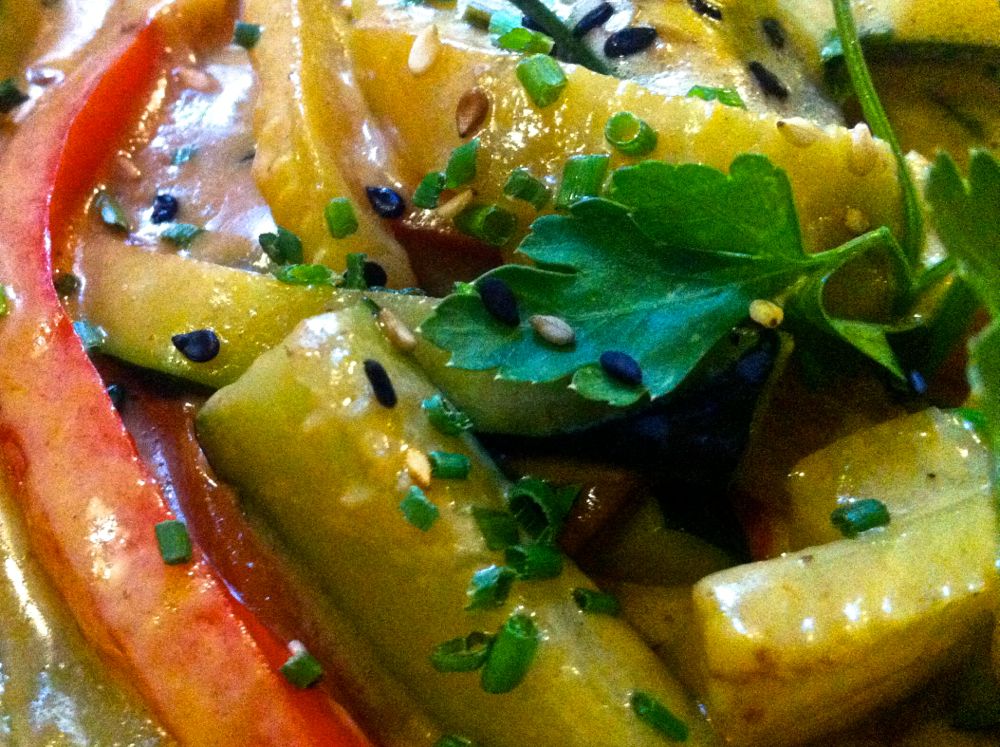
Now and then, I like to cook something Chinese. At least that’s what we call it although I rarely follow a Chinese recipe. With respect to the ingredients, Asian cooking would certainly be more adapted to: Ginger, soy and shoyou sauce, sweet and salty, red peppers and garlic… Together with all kinds of fresh vegetables according to the season, carrots, leek, mushrooms and all kinds of cabbage, stir and fry on hot fire in a wok together with some beef, marinated chicken or tofu, noodles for consistency or rice to absorb the juice.
Sometime it seems rather difficult to match the Asian tastes with wine. Many reds will quarrel with the salt of the soy sauce or the piquancy from peppers and ginger. Rosé wine might be fine, but we only think about it in summer, except some full-bodied and heavy rosé wines from southern France you may as well enjoy in winter.
Some two or three weeks ago, I stumbled over a bottle of Sauvignon blanc from the Languedoc, or that is to say from the Côtes de Thongue, that was patiently waiting in my fridge to be opened – a wine from Domaine de l’Arjolle 2011 (their wines are actually an essential part of my cellar for more than 10 years). I quickly wrung the neck of the bottle and cracked the screw cap to pour the wine in my glass. Freshly cut grass, lemon peel and some green apple, crispy and light on the palate, with grassy aromas and some bitterness on the final – simple but efficient.
At the table the wine doesn’t lose its composure, manoeuvring neatly between de different flavours of the dish. Its freshness handles the sweetness of the dark soy sauce, while its airiness soothes the heat of the pepperoni. As a surprise, the saltiness of the dish emphasizes sweetness in the wine, which I did not notice before, and matches even better with my homemade Asian food.





 RSS
RSS